
Signs of Grub Damage in Your Lawn and How to Prevent It
Published | By Field of Dreams Lawn Care
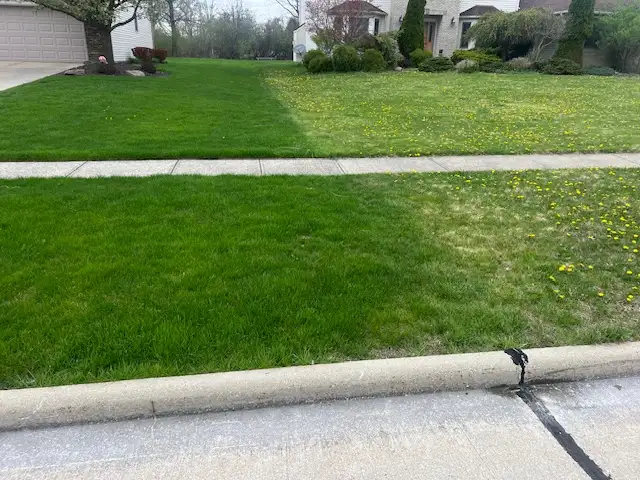
Brown, spongy patches of grass that peel up like carpet — plus animals digging in your yard overnight — are the telltale signs of grub damage. If you have noticed either of these symptoms in your Northeast Ohio lawn, white grubs are very likely feeding on your grassroots below the surface. The good news is that grub damage is both preventable and treatable — but timing makes all the difference.
What Are Lawn Grubs?
White grubs are the larval stage of several species of beetles, most commonly Japanese beetles, European chafers, and June bugs. Adult beetles lay their eggs in lawn soil during the summer months. When those eggs hatch, the larvae — white, C-shaped grubs roughly the size of a quarter — feed on grassroots just below the soil surface.
A single square foot of lawn can harbor 5 to 15 grubs before visible damage appears. Once populations exceed that threshold, the damage becomes obvious and accelerates quickly. Grubs feed most actively in late summer and early fall, though in Ohio's climate they can cause visible damage from August through October.
The Grub Lifecycle in Northeast Ohio
Understanding the grub lifecycle explains why timing is so critical for prevention. In Northeast Ohio, the cycle follows a predictable pattern tied to our seasons.
Adult Japanese beetles emerge from the soil in mid to late June and remain active through July. During this 4-6 week period, they feed on ornamental plants and roses during the day and return to lawns at night to lay eggs in the soil. A single female Japanese beetle can lay 40 to 60 eggs during her lifetime.
Eggs hatch in late July through August. The tiny larvae immediately begin feeding on grassroots, growing rapidly through the fall. As soil temperatures drop below 50 degrees in late October, grubs burrow deeper into the soil — typically 4 to 8 inches — to overwinter below the frost line.
In spring, grubs migrate back toward the surface to resume feeding briefly before pupating into adult beetles, and the cycle repeats. The spring feeding period (March through May) causes less visible damage than fall because grubs are nearly mature and eat less before pupation.
5 Signs of Grub Damage in Your Lawn
Grub damage is sometimes mistaken for drought stress, disease, or poor soil conditions. Here are the five most reliable indicators that grubs are the actual cause.
1. Brown Patches That Feel Spongy Underfoot
Grub-damaged turf feels soft and spongy when you walk on it because the roots have been severed. Drought-stressed grass, by comparison, feels firm and crispy. The spongy texture is caused by the layer of disconnected grass sitting on top of loosened soil where grubs have been actively feeding.
2. Turf That Peels Up Like Carpet
This is the most definitive sign. Grab a section of brown grass and pull it. If it lifts away from the soil easily — like peeling up a section of loose carpet — the roots have been eaten by grubs. Healthy turf resists pulling because intact roots anchor it firmly. When you peel back the damaged turf, you will likely see the white, C-shaped grubs in the exposed soil.
3. Animals Digging in Your Yard
Raccoons, skunks, crows, and starlings all feed on grubs. If you wake up to find your lawn torn up with small holes and sections of turf flipped over, animals have been digging for grubs overnight. In Northeast Ohio, raccoon and skunk activity is the most common secondary indicator. The animal damage is often worse than the grub damage itself — raccoons will tear up large sections of lawn in a single night.
4. Irregular Brown Patches in Late Summer or Early Fall
Grub damage typically appears as irregularly shaped brown patches, not uniform browning across the entire lawn. The patches often start small (1-2 feet across) and expand over weeks as the grub population grows. They tend to appear first in sunny areas because adult beetles prefer to lay eggs in warm, sun-exposed soil.
5. Increased Beetle Activity in June and July
Swarms of Japanese beetles feeding on your roses, ornamental trees, or vegetable garden in June and July is a warning sign for next season. Those beetles are laying eggs in your lawn at the same time. Heavy beetle activity one summer often predicts grub damage the following fall — making preventative treatment the smart approach.
Why Northeast Ohio Lawns Are Especially Vulnerable
Several factors make our region a high-risk area for grub damage. Ohio's warm, humid summers provide ideal conditions for Japanese beetle reproduction. Our heavy clay soils retain moisture, which grubs need to survive — grub mortality is higher in sandy, well-drained soils where eggs and young larvae dry out.
Additionally, the dense clay common throughout Cuyahoga, Lorain, Medina, and Summit counties compacts easily, creating stress on grassroots even before grubs begin feeding. A lawn growing in compacted clay soil with reduced root depth is far more susceptible to grub damage than a lawn with deep, healthy roots in aerated soil.
This is one of the reasons we recommend annual core aeration for all Northeast Ohio lawns — deeper roots withstand more grub feeding before visible damage occurs.
Prevention vs. Cure: Why Timing Matters
Preventative grub control and curative grub control are two very different approaches, and the difference in effectiveness is significant.
Preventative treatments are applied in late spring to early summer (late May through June) before grubs hatch. These products create a residual barrier in the soil that kills larvae as they emerge from eggs. When applied at the right time, preventative treatments are 80-95 percent effective at eliminating grub populations.
Curative treatments are applied in late summer or early fall after grub damage is already visible. While curative products can reduce existing grub populations, they are less effective because the grubs are larger and harder to kill. Curative treatment also cannot undo damage that has already occurred — the dead turf still needs to be repaired through overseeding.
The bottom line: it costs less and works better to prevent grubs in June than to treat active damage in September. Our grub protection service is timed specifically to the Japanese beetle lifecycle in Northeast Ohio, applied during the narrow window when prevention is most effective.
How to Tell the Difference Between Grub Damage and Other Lawn Problems
One of the most common mistakes homeowners make is confusing grub damage with drought stress, fungal disease, or poor soil conditions. Knowing how to distinguish between these problems saves time and money on treatment. If you are wondering what grub damage looks like on a lawn, there are a few reliable ways to tell it apart from other issues.
Grub damage vs. drought stress: Both produce brown patches, but drought-stressed turf turns uniformly brown across large, exposed areas and feels dry and crispy underfoot. Grub-damaged turf produces irregular brown patches that feel soft and spongy. The definitive test is the tug test — drought-stressed grass holds firm because the roots are intact (just dehydrated), while grub-damaged grass lifts away because the roots have been eaten.
Grub damage vs. fungal disease: Common lawn diseases like brown patch and dollar spot create distinct circular patterns with defined borders, often with a darker ring of active fungal growth around the perimeter. Grub damage produces irregular shapes with no defined border. Fungal damage also does not cause turf to separate from the soil — the root system remains attached even when the grass blade is affected.
Grub damage vs. animal digging: When raccoons, skunks, or crows dig through your lawn overnight, they are not causing the primary damage — they are revealing it. The grubs were already there destroying roots. The animals are simply mining for food. If you repair the surface damage without treating the grubs, the animals will return because the food source remains.
When a lawn is destroyed by grubs, the recovery path depends entirely on catching the problem at the right stage. Homeowners who notice grub holes in grass or spongy brown patches in August still have time for curative treatment before the grubs burrow deep for winter. By November, the window closes until spring.
Common Grub Species in Northeast Ohio
Not all grubs are created equal, and understanding which species are present in your lawn affects treatment timing and product selection. Three species account for virtually all grub problems in lawns across the Greater Cleveland area.
Japanese beetle grubs are the most common and most damaging species in Cuyahoga, Lorain, and Medina counties. The adults are the metallic green-and-copper beetles that swarm roses and linden trees from mid-June through July. Their larvae are white, C-shaped, and grow up to one inch long. Japanese beetle grubs feed aggressively on cool-season grass roots from August through October, making them the primary cause of fall lawn damage in our area.
European chafer grubs are slightly larger than Japanese beetle grubs and are becoming more prevalent across Northeast Ohio. Adult European chafers are tan-brown beetles that swarm at dusk during late June — you may notice them flying around treetops in large numbers on warm evenings. Their feeding pattern is similar to Japanese beetles, but chafer grubs tend to feed slightly later into fall and resume feeding earlier in spring, extending the damage window.
Masked chafer (annual white grubs) are smaller than the other two species and cause less dramatic damage per individual grub. However, masked chafer populations can reach higher densities — sometimes 30 or more per square foot — compensating for their smaller size with sheer numbers. These grubs are the most likely culprit when homeowners notice what looks like a yard with grubs but without the severe brown patches associated with Japanese beetles.
All three species respond to the same preventative treatment products when applied during the correct window. Our grub protection service uses products effective against all three species, timed to the earliest egg-hatch date in our region.
What to Do If You Already Have Grub Damage
If you are reading this in late summer or fall and your lawn already shows signs of grub damage, there are still steps you can take. A curative grub treatment will reduce the active population and prevent further feeding. Once grubs are controlled, the damaged areas should be reseeded in early to mid-September when soil temperatures favor germination.
Combining curative grub treatment with fall aeration and overseeding is the most effective repair strategy. Aeration loosens the compacted soil, and overseeding fills in the bare patches. With proper fall fertilization, most grub-damaged lawns recover fully by the following spring.
For the following year, switch to a preventative approach. Once a lawn has had grub damage, the conditions that attracted beetles — warm soil, adequate moisture, healthy turf for egg-laying — will attract them again.
Protect Your Lawn Before Grubs Strike
Field of Dreams Lawn Care has been treating Northeast Ohio lawns for grub damage and prevention since 1997. We know the local beetle populations, the soil conditions, and the optimal treatment timing for our area.
If you have noticed signs of grub damage, or if you want to prevent it before it starts, call us at 216-328-0551 or request a free estimate. We serve homeowners across Independence, Cleveland, and 50+ communities throughout Northeast Ohio.